
The lead nurturing process is a deliberate, automation-first sequence of multi-channel, behaviour-triggered touches that converts prospects into customers. Start this week with three actions: map one buyer journey end-to-end, set a single high-intent trigger (pricing page visit, demo request), and activate a basic welcome sequence.
- Map one buyer journey from first touch to signed contract
- Tag one high-intent behaviour in your CRM and set an automated alert
- Launch a three-email welcome sequence for new enquiries
Pro Tip: Responding promptly to inbound interest significantly increases the likelihood that leads will qualify compared to longer wait times. Automate that first response — even a plain-text acknowledgement.
Table of Contents
- What does the lead nurturing process actually cover?
- Stage-by-stage checklist: define, segment, score, map, automate, measure.
- How to build automated nurture workflows that actually convert
- Which channels work for nurturing in Australia?
- Australian compliance: Spam Act, consent, and the Privacy Principles
- KPIs and experiments that reliably improve conversion rates
- Ready-to-use nurture sequence templates for B2B service businesses
- What breaks nurturing programmes and how to fix them fast
- When should you hire a specialist instead of building in-house?
- Key takeaways
- Why automation-first nurturing wins — and where most teams get it wrong
- How Tyson Kaye accelerates your lead nurturing with AI and automation
- Useful sources and further reading
What does the lead nurturing process actually cover?
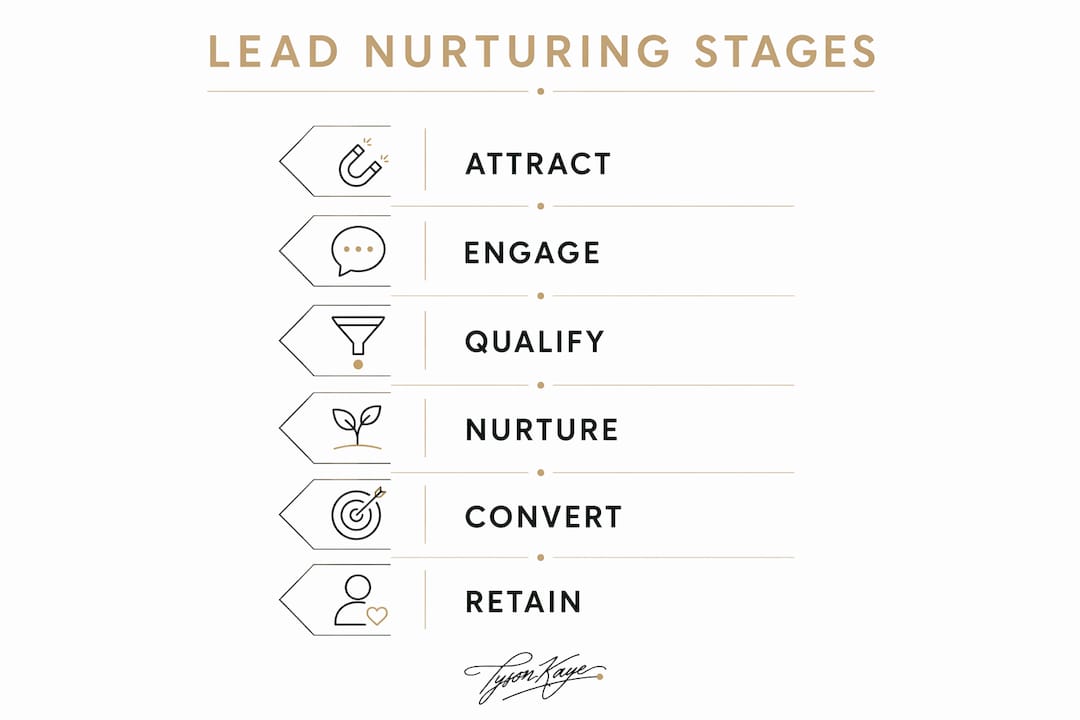
The process spans six stages: attract, engage, qualify, nurture, convert, and retain. Everything between a stranger discovering your brand and a signed client renewing their contract sits inside this loop.

In scope: segmentation, lead scoring, content mapping to buyer stages, automated workflows, multi-channel orchestration, CRM integration, measurement, and Australian compliance under the Spam Act 2003 and the Australian Privacy Principles (APPs).
Out of scope: paid media creative production, deep API development tutorials, or formal legal advice. This guide gives practical compliance pointers — confirm specifics with a qualified legal adviser for your situation.
B2B purchases are complex, involving multiple stakeholders with different priorities, extended timelines, and formal approval processes. Complex B2B solutions often span six to eighteen months with many stakeholders involved — design your nurturing to match that reality, not a two-week email drip.
Stage-by-stage checklist: define, segment, score, map, automate, measure.
Follow these six stages in order. Skip one and the system leaks.
- Define — Document your ideal customer profile, pain points, and the decision-making unit (who signs, who influences, who blocks).
- Segment — Group contacts by behaviour first, firmographics second. Behavioural clustering (video view percentage, product-page visits) surfaces buyer intent more reliably than demographic lists alone.
- Score — Assign points to actions. A practical starting threshold: 50 points for MQL, 80 for SQL, then recalibrate against your actual conversion history every quarter.
- Map content — Match assets to funnel stage using the table below.
- Automate — Build behaviour-triggered sequences, not calendar drips.
- Measure — Track open rate, click-through rate (CTR), MQL-to-SQL conversion, and time-to-convert weekly.
| Funnel stage | Buyer intent signal | Content type | Trigger |
|---|---|---|---|
| TOFU (Awareness) | First site visit, ad click | Blog post, short video, checklist | Page visit |
| MOFU (Consideration) | Pricing page, case study download | Webinar, comparison guide, ROI calculator | Content download |
| BOFU (Decision) | Demo request, proposal viewed | Case study, proposal follow-up, testimonial | Form submission |
B2B buyers typically consume multiple pieces of content before contacting sales. Structure your content progression so each asset assumes familiarity with the previous one.
How to build automated nurture workflows that actually convert
Calendar drips send emails on a schedule regardless of what the prospect just did. Behaviour-triggered workflows respond to real intent signals. The difference in conversion rates is not subtle.
- Choose a trigger — pricing page visit, whitepaper download, webinar registration, or missed call.
- Define the branch — if the lead scores above 50, route to a sales alert; below 50, continue nurturing with educational content.
- Set exit conditions — a lead who books a call exits the sequence immediately. A lead who unsubscribes exits and is flagged, not deleted.
- Define the sales handoff SLA — sales contacts an MQL within four business hours of the trigger firing.
- Test before launch — send test contacts through every branch, check merge fields, confirm unsubscribe links work.
Production-ready workflow checklist:
- Segmentation tags applied before sequence entry
- Personalisation tokens tested (first name, company, industry)
- Fallback content set for missing field values
- Unsubscribe link present in every email
- Sales notification configured at MQL threshold
Only 35% of B2B marketers run automated nurture sequences. Teams that use automation generate 50% more sales-ready leads at a 33% lower cost, with the advantage growing over time.
Pro Tip: Start with a single high-value entry point — demo request or pricing page — for your first automation pilot. Prove lift there, then scale to other triggers.
Which channels work for nurturing in Australia?
Email remains the backbone, but multi-channel orchestration is what separates average programmes from high-performing ones. For Australian B2B service buyers, the practical channel mix looks like this:
| Channel | Primary role | Best for | Relative impact |
|---|---|---|---|
| Education, follow-up | All stages | High | |
| Awareness, social proof | TOFU/MOFU | High for B2B | |
| Webinars | Trust, live Q&A | MOFU | High |
| Retargeting ads | Re-engagement | MOFU/BOFU | Medium |
| Phone/SMS | Decision-stage push | BOFU | High (short cycle) |
| Chatbot/live chat | Instant qualification | TOFU | Medium |
For LinkedIn B2B outreach, sequence a connection request on day one, a value-add message on day five, and a case study share on day twelve — before any sales ask.
Pro Tip: Cap total touches at 10–13 per 90-day period for mid-market B2B buyers. Beyond that, fatigue sets in and unsubscribe rates climb. Quality of touch matters more than frequency.
Australian consent reminder: under the Spam Act 2003, every commercial electronic message requires express or inferred consent, a clear sender identification, and a working unsubscribe mechanism. SMS and email both fall under this obligation.
Australian compliance: Spam Act, consent, and the Privacy Principles
Non-compliance costs more than deliverability. The Australian Communications and Media Authority (ACMA) enforces the Spam Act 2003, and the Office of the Australian Information Commissioner (OAIC) oversees the APPs.
Practical compliance checklist:
- Capture express consent at every opt-in form with a clear description of what the subscriber will receive
- Record consent method, date, and source in your CRM
- Include sender name, ABN or address, and an unsubscribe link in every commercial email and SMS
- Process unsubscribe requests within five business days
- Retain consent records for at least five years
- Review your privacy policy annually against the current APPs
For official guidance, visit acma.gov.au for spam obligations and oaic.gov.au for privacy requirements. These are your primary sources — not SEO guides.
KPIs and experiments that reliably improve conversion rates
Measure at every stage, not just at the end. The table below maps engagement signals to the downstream outcomes they predict.
| KPI | Stage | Target range | What it tells you |
|---|---|---|---|
| Email open rate | TOFU/MOFU | — | Subject line and list health |
| CTR | MOFU | 3–8% | Content relevance |
| MQL-to-SQL rate | Qualification | — | Scoring accuracy |
| Lead-to-opportunity | Nurture | 10–20% | Sequence effectiveness |
| Time-to-convert | All | Benchmark vs. baseline | Cadence efficiency |
| Revenue per lead | All | Track monthly | Programme ROI |
Experiment prioritisation:
- Test subject lines first — highest leverage, fastest results.
- Test send timing second (Tuesday–Thursday mornings tend to perform well for Australian B2B audiences).
- Test CTA copy third.
- Run one experiment at a time per sequence to isolate variables.
- Require at least 200 sends per variant before drawing conclusions.
When done right, lead nurturing generates 50% more sales-ready leads at a 33% lower cost. That benchmark is worth keeping visible on your dashboard as a programme-level target.
Ready-to-use nurture sequence templates for B2B service businesses
Three sequences cover most service-business scenarios. Copy, adapt, and launch.
30-day sequence (short sales cycle)
- Day 1: Welcome email — confirm opt-in, set expectations, link to one high-value resource
- Day 3: Educational email — address the top pain point, no sales language
- Day 7: Social proof — brief case study or client result
- Day 14: Soft CTA — invite to a 15-minute discovery call
- Day 21: Re-engagement check — "Still relevant?" with a single yes/no link
- Day 30: Final value email — share a tool or template, close the sequence
90-day sequence (mid-market B2B)
Weeks 1–2: Welcome + education (email). Week 3: Webinar invite (email + LinkedIn). Week 4: Webinar follow-up with recording. Weeks 5–8: Case study series, one per fortnight. Week 9: ROI calculator or self-assessment tool. Week 10: Retargeting ads activated for non-openers. Week 12: Sales handoff trigger if score reaches 50.
180-day sequence (complex enterprise)
Months 1–2: Education track (blog series, thought leadership). Month 3: Webinar or live event invite. Month 4: Stakeholder-specific content (separate tracks for CFO, operations lead, end user). Month 5: Proposal-readiness content (implementation guides, compliance docs). Month 6: Direct sales outreach with full engagement history attached.
Personalisation rules:
- Use first name and company name tokens in every email
- Set fallback values ("there" for first name if blank)
- Route to sales when score hits 80 or when a BOFU trigger fires, whichever comes first
What breaks nurturing programmes and how to fix them fast
Red flags to watch for:
- Calendar-only drips with no behaviour triggers
- Leads scoring high on email opens but never on site visits (vanity engagement)
- Current customers still receiving prospect sequences
- No defined MQL-to-sales handoff SLA
- Sequences running for 12+ months with no exit condition
Immediate fixes:
- Audit your active sequences — add exit conditions for existing customers today.
- Prune your list: suppress contacts with zero engagement in 180 days before attempting re-engagement.
- Launch a re-engagement branch for dormant leads. Targeted re-engagement sequences can revive between 12% and 18% of cold leads at a lower cost than new acquisition.
- Book a 30-minute sales-marketing alignment meeting to agree on MQL definition and handoff SLA.
- Check that unsubscribe links function in every live sequence — ACMA compliance, not optional.
Validation tests: after fixes, monitor MQL-to-SQL rate for 30 days. If it rises, the fix worked. If it stays flat, the problem is scoring criteria, not sequence content.
When should you hire a specialist instead of building in-house?
Build in-house when you have a dedicated marketing operations person, a clean CRM, and fewer than three active sequences. Bring in a specialist when any of these apply:
- Your CRM data is fragmented across two or more systems
- You need custom API integrations between your CRM, website, and phone system
- Your team has no prior automation build experience
- You have a hard deadline (product launch, campaign window) under eight weeks away
- You've tried to build sequences twice and they've broken or gone unmaintained
RFP checklist for a systems integrator:
- Discovery scope: do they audit your existing data before quoting?
- Data model: will they document the field mapping and tagging logic?
- Handoff SLA: what is the agreed response time for MQL alerts?
- Privacy obligations: do they build consent capture and unsubscribe into every sequence?
- Testing plan: do they run end-to-end tests before go-live?
Pro Tip: Ask for a fixed-fee pilot engagement covering one sequence end-to-end. Demand measurable outcomes — MQL volume, time-to-respond, or conversion rate — before committing to a full build. A specialist who won't agree to defined outcomes is not worth hiring.
A simple, well-integrated tool stack can outperform a larger, less integrated collection of tools—fewer tools, better connected.
Key takeaways
A well-designed lead nurturing process built on behaviour triggers, clean segmentation, and CRM integration generate 50% more sales-ready leads at a 33% lower cost than ad-hoc follow-up.
| Point | Details |
|---|---|
| Start with behaviour triggers | Replace calendar drips with triggers tied to real intent signals like pricing page visits or demo requests. |
| Score leads with clear thresholds | Use a starting threshold of 50 points for MQL and 80 points for SQL, adjusting quarterly based on actual conversion rates. |
| Match content to funnel stage | B2B buyers typically consume 3–7 pieces of content before contacting sales — map TOFU, MOFU, and BOFU assets deliberately. |
| Stay compliant in Australia | Every commercial email and SMS needs consent, sender ID, and a working unsubscribe under the Spam Act 2003. |
| Tyson Kaye builds the system for you | Tyson Kaye designs and implements CRM integration, AI agents, and automated sequences that save clients up to 20 hours per week. |
Why automation-first nurturing wins — and where most teams get it wrong
Most nurturing programmes fail not because of bad content but because of bad architecture. A team can write excellent emails and still lose deals because the sequence fires on a Tuesday regardless of what the prospect did on Monday. The trigger is the thing.
What I see consistently across service businesses is this: the first automation they build is a welcome sequence, and it works well enough that they stop there. The real gains come from the second and third layers — the re-engagement branch for cold leads, the stakeholder-specific track for enterprise deals, the sales alert that fires within minutes of a pricing page visit. Those layers are where the 50% more sales-ready leads figure actually comes from.
Start small. One trigger, one sequence, one measurement. Prove it works, then add the next layer. Clients who've gone through this process with Tyson Kaye have saved up to 20 hours a week in admin time and seen organic traffic grow by over 205% in 90 days — not because the content was revolutionary, but because the system was built to capture and respond to intent signals that were previously going unnoticed.
The teams that win at nurturing are not the ones with the biggest content library. They're the ones whose CRM knows what a prospect did five minutes ago and responds accordingly.
How Tyson Kaye accelerates your lead nurturing with AI and automation
Businesses in New South Wales running long B2B sales cycles often have the leads — they just don't have the system to convert them. Tyson Kaye builds that system: CRM integration, AI agents, behaviour-triggered sequences, and lead recovery workflows, all designed around your specific sales process.
The work covers diagnosis, design, build, test, and handoff — a fixed-fee engagement with defined outcomes, not an open-ended retainer. Clients have saved up to 20 hours per week in admin time and achieved over 205% organic traffic growth in 90 days. The Tyson Kaye services page outlines the full scope. Book a discovery call to get a diagnosis of where your current funnel is leaking and what it would take to fix it.
Useful sources and further reading
- Spam Act 2003 guidance — ACMA: official source for commercial electronic message obligations in Australia
- Australian Privacy Principles — OAIC: governing framework for data collection and retention
- B2B Lead Nurturing Strategies — monday.com: practical framework for multi-stakeholder buying groups
- Automated Lead Nurturing guide — Sendspark: step-by-step automation architecture and re-engagement data
- AI Lead Nurturing playbook — Sendspark: behavioural triggers, predictive scoring, and staged AI adoption
- Lead Nurturing strategy guide — Utiliko: scoring thresholds, content mapping, and conversion benchmarks
- What Is Lead Nurturing — Salesforce: buyer persona frameworks and sales cycle alignment
- Automated Lead Nurturing — Salesforce: CRM integration requirements and data governance
This article is general information for marketing practitioners and business owners. It is not legal advice. Confirm your compliance obligations under the Spam Act 2003 and the Australian Privacy Principles with a qualified legal adviser or directly with ACMA and the OAIC.