
For high-volume Australian service businesses, the right path is a Business Messages API integration with CRM and a custom AI agent. Native Google Business Profile chat works as a low-effort fallback, but it will not scale with your lead volume or give you the conversion data you need.

The case for acting now is straightforward. Around 75% of consumers prefer engaging with a brand through private messaging over traditional channels. If your GBP listing is not capturing and qualifying those conversations automatically, you are handing leads to whoever is.
Three immediate actions:
- Audit your Google Business Profile data: hours, services, descriptions, and attributes must be accurate before any AI agent goes live.
- Decide between native GBP chat (fast to deploy, limited capability) and Business Messages API (webhook-driven, CRM-integrated, built for volume).
- Schedule a pilot with defined success metrics: leads captured, appointments booked, and CSAT score.
Tyson Kaye works with established Australian service businesses to build exactly this kind of integrated system, from GBP readiness through to custom AI agents and CRM automation.
Table of Contents
- Which Google messaging approach suits your business?
- What each approach can and cannot do for lead conversion
- How do you choose between native chat, API, or a specialist?
- Implementation checklist, timeline, and Australian cost bands
- Australian legal and privacy requirements for GBP messaging
- How a specialist integrator approaches this
- Key takeaways
- What most businesses get wrong with GBP messaging
- Build the system that converts, not just chats
- Useful sources and further reading
Which Google messaging approach suits your business?
The four viable approaches differ sharply on capability, complexity, and cost. The table below maps them against the dimensions that matter most for service operations.
| Approach | Best for | Core features | CRM & webhook | Scalability / SLA | Implementation complexity | Est. cost / time | Verification / brand display | Analytics / CSAT |
|---|---|---|---|---|---|---|---|---|
| Native GBP chat | Low volume, single location, quick coverage | Basic text, welcome message, AI agent (pilot), handoff tabs | None natively | Low; no concurrency control | Minimal (hours) | Near zero | No verified branding | Basic only |
| Business Messages API | High volume, multi-location, lead conversion | Rich cards, carousels, suggested replies, async, webhooks | Full webhook + CRM integration | High; custom SLA possible | High (weeks) | $5,000–$30,000+ | Verified brand agent | Full CSAT, lead scoring |
| Third-party connectors | Mid-volume, existing helpdesk or CRM | Depends on connector; typically text + basic routing | Partial; depends on platform | Medium | Medium (days to weeks) | Varies | Limited | Partial |
| RCS / verified messaging | Commerce, appointment flows, high-trust campaigns | Rich cards, fallback to SMS, in-message payments, verified branding | Via messaging provider | Medium–high | Medium–high | Varies by provider | Full verified branding | Partial |
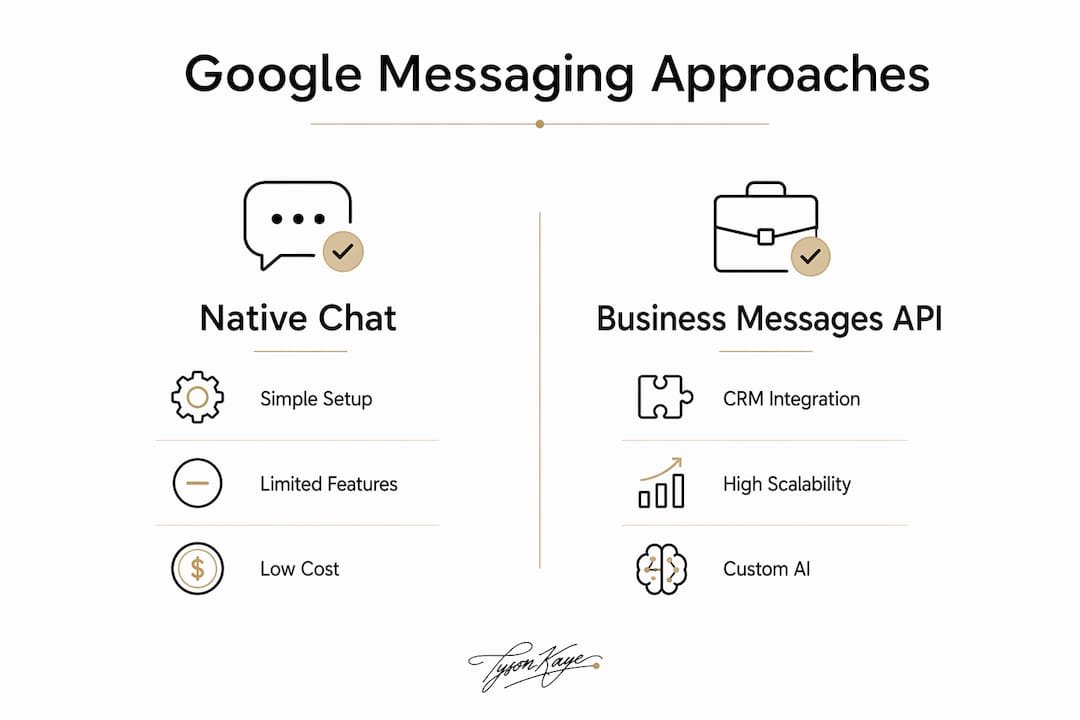
Verdict: For established service businesses handling meaningful lead volume, Business Messages API is the only approach that maps conversations to CRM records, supports custom AI qualification flows, and gives you measurable conversion data. Native chat covers you while you build.
What each approach can and cannot do for lead conversion
The Business Messages API is purpose-built for conversion. It supports webhooks, carousels, suggested replies, and CRM integration, which means a conversation that starts on Google Search or Maps can route directly into your pipeline, trigger a booking flow, and capture a CSAT score without any manual handling.
Capabilities that materially affect conversion:
- Rich cards and carousels let customers browse services or select appointment slots inside the chat window.
- Suggested replies reduce friction and guide customers toward qualification questions.
- Async messaging means neither party needs to be present simultaneously, which suits service businesses with after-hours enquiries.
- Webhooks deliver every message as a JSON payload to your defined endpoint, enabling real-time CRM record creation and lead scoring.
- CSAT capture and analytics give you a feedback loop to improve both AI and human responses over time.
Limits and risk areas worth knowing:
- The native GBP AI agent draws entirely on your listing data. Stale hours, missing service descriptions, or vague attributes produce inaccurate automated responses.
- The pre-2024 GBP chat was decommissioned on 31 July 2024; historic chat data is irretrievable unless it was exported via Google Takeout before 30 August 2024. Any strategy built on legacy chat history needs to start fresh.
- If you add both WhatsApp and SMS to your GBP chat settings, Google displays only the SMS option to customers.
- RCS verified messaging is not end-to-end encrypted; chats are managed by businesses, messaging providers, and carriers.
Pro Tip: Treat your Google Business Profile like the primary knowledge base for your AI agent. Every field, from trading hours to service descriptions and attributes, directly determines the accuracy of automated responses. An agent is only as good as the listing data it reads.
How do you choose between native chat, API, or a specialist?
Start with volume and lead value. If your business receives fewer than 50 enquiries per month and each job is under $500, native GBP chat is adequate. Above that threshold, the economics of a Business Messages API integration pay off quickly.
Decision criteria checklist:
- Expected monthly message volume (under 50 vs. 50–500 vs. 500+)
- Average lead value and conversion rate from chat
- Whether you need messages mapped to CRM records
- Verification requirements (RCS verified branding for high-trust campaigns)
- Concurrency needs and SLA commitments
- Data residency concerns for webhook and CRM logs
- Measurement requirements: CSAT, lead-to-booked conversion, response SLA
Questions to ask any vendor or integrator:
- Which CRM platforms do you integrate with, and how are webhook failures handled?
- What is your message throughput SLA under peak load?
- How do you control AI agent tone, scope, and escalation thresholds?
- What analytics and CSAT reporting do you provide out of the box?
- What does ongoing support cost, and what is included?
- Do you provide a staging environment for testing before go-live?
Red flags: any integrator who cannot map messages to CRM records, cannot explain their AI handoff logic, or has no staging environment is a risk. Opaque AI behaviour and no escalation workflow are the two most common causes of failed implementations.
Implementation checklist, timeline, and Australian cost bands
A staged approach reduces risk and gives you early data to justify the full build.
Staged checklist:
- Audit and cleanse all GBP listing data (hours, services, attributes, photos).
- Define success metrics before build: leads captured, appointments booked, CSAT target, response SLA.
- Design conversation flows, qualification questions, and human handoff points.
- Build API and webhook integration to your CRM with lead-scoring rules.
- Test in a staging environment with synthetic traffic.
- Pilot with limited live traffic (one location or one service line).
- Monitor metrics, refine flows, then scale.
| Phase | Typical duration |
|---|---|
| Audit and GBP cleanse | 1–2 weeks |
| Conversation design | 1–2 weeks |
| API / webhook build | 2–4 weeks |
| Staging and testing | 1–2 weeks |
| Pilot (limited traffic) | 2–4 weeks |
| Scale and optimise | Ongoing |
Australian cost bands for a Business Messages API implementation with custom AI and CRM integration:
- Entry-level (single location, basic flows, existing CRM): $5,000–$10,000
- Mid-range (multi-location, custom AI agent, moderate CRM complexity): $10,000–$20,000
- Enterprise (high concurrency, complex CRM, full analytics, multi-channel): $20,000–$30,000+
Staffing note: assign a named owner for handoff and escalation before go-live. The native GBP Messages interface organises conversations into "Handled by your AI agent" and "Needs your attention" tabs, so someone on your team must own the second tab and know when to escalate.
Australian legal and privacy requirements for GBP messaging
The Australian Privacy Principles (APPs) under the Privacy Act 1988 apply to any business with an annual turnover above $3 million that collects personal information through messaging. For most established service businesses, that means GBP messaging conversations are covered.
Key obligations:
- Obtain clear consent before sending outbound messages; transactional replies to an inbound enquiry generally satisfy legitimate interaction requirements, but marketing follow-ups require explicit opt-in.
- The Spam Act 2003 requires that all commercial electronic messages include a functional unsubscribe mechanism and sender identification. Automated follow-up sequences triggered by a GBP conversation must comply.
- Capture consent in-conversation where possible (a suggested reply confirming the customer agrees to receive follow-up messages is a practical approach).
- Define and document your retention policy for chat logs and CRM records; the APP requires you to destroy or de-identify personal information you no longer need.
- Webhook and CRM integrations that route data to offshore servers (common with US-based CRM platforms) trigger APP 8 cross-border disclosure obligations. Confirm your CRM provider's data residency settings before go-live.
- The decommission of legacy GBP chat on 31 July 2024 is a reminder that platform-held data can disappear. Keep your own records.
How a specialist integrator approaches this
Tyson Kaye has implemented integrated messaging and AI automation systems for Australian service businesses across accounting, nursing, building services, and virtual assistance. The pattern is consistent: audit the GBP listing, design the conversation flows, build the API and CRM integration, run a controlled pilot, then scale.
Measured outcomes from client engagements include saving up to 20 hours per week in administrative time and delivering over 205% growth in organic traffic within 90 days. The MS Accountants case illustrates how a service business with high enquiry volume can systematise lead capture and reduce manual follow-up without adding headcount.
The methodology works because it treats GBP data accuracy as a prerequisite, not an afterthought. Businesses that skip the audit phase consistently see lower AI response accuracy and higher escalation rates.
Key takeaways
For high-volume Australian service businesses, Business Messages API integration with CRM and a custom AI agent is the only approach that converts Google Search and Maps enquiries into measurable, trackable revenue.
| Point | Details |
|---|---|
| API beats native chat at scale | Business Messages API supports webhooks, CRM integration, and CSAT capture; native chat does not. |
| GBP data is the AI knowledge base | Accurate hours, services, and attributes directly determine automated response quality. |
| Compliance is non-negotiable | Australian Privacy Principles and the Spam Act 2003 apply to messaging; document consent and retention before go-live. |
| Staged implementation reduces risk | Audit, design, build, test, pilot, then scale; skip staging and you will find problems in production. |
| Tyson Kaye as specialist integrator | Tyson Kaye scopes and builds Business Messages API, CRM, and AI agent systems for Australian service businesses, with projects from $5,000 to $30,000+. |
What most businesses get wrong with GBP messaging
The biggest mistake is treating GBP messaging as a chat widget rather than a conversion system. Businesses spend weeks debating which AI tool to use and zero time auditing the listing data that AI will actually read. The agent then confidently gives customers the wrong trading hours or quotes a service the business stopped offering two years ago.
The second mistake is no handoff policy. The "Needs your attention" tab fills up, nobody owns it, and leads go cold. A well-built system is worthless if the human side of the handoff is undefined.
What the successful implementations share is unglamorous: clean listing data, a named escalation owner, and a staging environment where flows are tested before customers see them. The technology is the easy part.
Build the system that converts, not just chats
Twenty hours a week in recovered admin time and 205% organic growth in 90 days are outcomes from the same underlying discipline: building systems where every customer touchpoint, including a Google Maps message at 9pm, routes into a qualified pipeline rather than a missed notification.
Tyson Kaye diagnoses, designs, and builds custom AI agents, CRM integrations, and GBP-ready automation systems for established Australian service businesses. Projects are fixed-fee and scoped to your operation, typically ranging from $5,000 to $30,000+ depending on location count, CRM complexity, and AI agent scope. Pilot options are available for businesses that want to validate the approach on a single location before committing to a full rollout.
Book a discovery call to scope your integration and get a clear picture of what a Business Messages API build would cost and deliver for your business.
Useful sources and further reading
Technical setup and API documentation:
- Business Messages developer documentation — full feature list, webhook architecture, and integration guides; start here for technical scoping.
- How Business Messages works — explains the agent model, entry points from Search and Maps, and message routing.
- RCS for Business overview — verified branding, rich card formats, SMS fallback, and commerce capabilities.
Compliance and platform changes:
- Changes to GBP chat and call history — official notice on the 31 July 2024 decommission and Takeout export window; essential reading if you relied on legacy chat data.
- GBP chat settings — current options for WhatsApp, SMS, and display behaviour.
Strategy and AI agent context:
- Partoo: Google reintroduces GBP messaging with an AI agent — detailed walkthrough of the new native AI agent, handoff tabs, and listing-as-knowledge-base implications.
For legal and compliance guidance specific to your business structure, consult the Office of the Australian Information Commissioner for APP obligations and the Australian Communications and Media Authority for Spam Act requirements. This article is general information, not legal advice; confirm your obligations with a qualified adviser for your specific situation.